No scaffolding to pay for first
Nothing to erect and nothing to dismantle, so the cost of looking is not the cost of a scaffold on a job that may not need one.
We want to use Google Analytics to see how the site is used, and Google Ads to measure our adverts and show them to you later. Google may also use your visit for its own purposes. Nothing loads from Google unless you agree; you can change your mind. How we use them

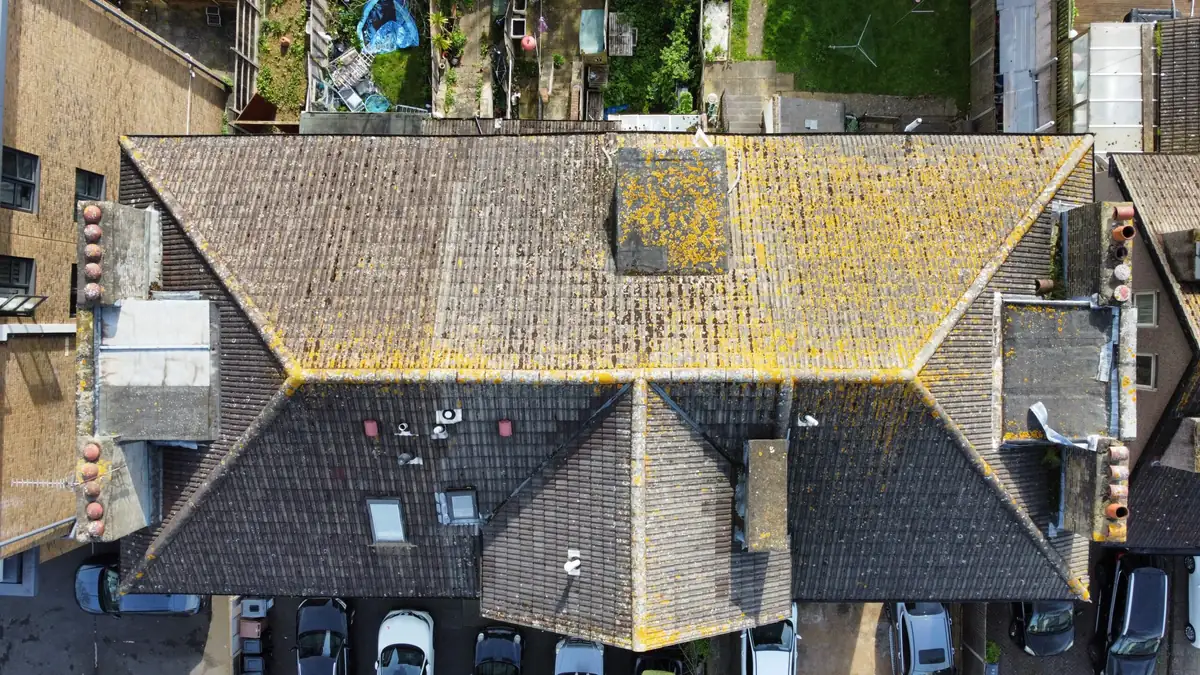
A high-resolution survey of your roof from the air, with no scaffolding, no ladders and nobody walking on the covering. You get the photographs and an honest account of what they show.
Book a drone surveyA drone roof survey is a photographic inspection carried out from the air, close enough to read an individual cracked tile or a split in a lead flashing, and it is for anyone who needs to know the condition of a roof they cannot safely get onto: homeowners with a steep slate pitch, buyers who want to know what they are taking on before exchange, landlords and agents responsible for a roof they have never seen, and businesses whose roof carries plant and cannot be walked without a permit.
People call it a drone roof survey, a drone roof inspection or an aerial roof inspection, and all three mean the same visit. If you want the distinction that actually matters: the survey is the visit, the flight, the photographs and the record of what is up there. The inspection is the judgement made on them, which is where a roofer looking at a lifted slate decides whether it is one slate or the first of forty. We do both, and the second is the part worth paying for.
The practical difference from a traditional inspection is what it costs to look. On a tall or steep roof the access is frequently more expensive than the repair it was erected to investigate. A flight takes that cost off the front of the job, so the decision about spending money on scaffolding is made after somebody has seen the roof rather than before.
A survey is most useful repeated rather than commissioned once in a crisis, because two sets of photographs a year apart show what is moving and what is stable. That is why a flight is one of the items in our planned roof care and maintenance service, alongside gutter clearing, roof cleaning and roofline repairs.
Where the survey turns into work, it is usually one of two things: pitched roof repair and re-roofing on the slate and tile side, or flat roof waterproofing on a parapet roof or an extension.
Nothing to erect and nothing to dismantle, so the cost of looking is not the cost of a scaffold on a job that may not need one.
Close, square-on photographs of every slope, valley, parapet and stack, including the faces that point away from the street.
No weight on brittle tiles, aged slate or a fragile rooflight, and no one working at height to find out whether there is a problem.
You keep the photographs, dated. That matters for an insurer, a buyer or a leaseholder.
A roof hides its failures from the two places people normally look at it from, which are the ground and the loft. These are the ones that only appear from above.
On a parapet roof the gutter, the outlet and the whole flat area sit behind a wall built specifically to hide them from the street. Nothing about their condition is visible from the pavement, the garden or the loft, and the first symptom is usually damp at the top of a wall months after the failure started.
Individual faults matter less than their distribution. Three slipped slates in one place is a repair; the same three scattered across an elevation means the nails are failing everywhere and the roof is finished. That is a judgement about a whole slope at once, and only a photograph from above shows a whole slope at once.
See pitched roof repair and re-roofingA chimney stack has four faces and you can see one of them from the street. The flaunching on top, the pointing on the far side and the lead soakers where the stack meets the tiles are where stacks actually fail, and all three are out of sight from every position at ground level.
A valley between two pitches collects everything that lands on both. Under trees it fills, holds water against the lining all winter and gives no external sign until the lining goes. Looking straight down into the run is the only way to see how much is in there.
See guttering and rainwater goodsPonding shows as a stain, an outline of dried silt or a change in texture, and it reads clearly from directly overhead and barely at all from an oblique angle. Where it sits tells you whether the falls were wrong from the start or the deck has since deflected.
See flat roof repair and waterproofingSix situations account for almost every one of the drone roof inspections we fly. What changes between them is not the flight, it is what the report has to answer.
Wind damage is scattered and frequently nowhere near the part of the roof that started leaking. A flight covers every elevation, including the ones facing away from the weather, and dates the damage with photographs while the cause is still obvious.
A homebuyer survey looks at the roof from the ground with binoculars and says so in the report. A flight gets you the condition of the covering, the stacks and the flashings before exchange, which is while you can still do something about the price.
Most roof disputes are arguments about something none of the parties has seen. Photographs of which side of a party boundary a valley has failed on, or which of three properties a shared gutter is blocked at, move it off opinion.
Insurers ask for dated photographs of the damage and an account of what caused it. A survey flown after the event produces exactly that, and it also establishes the condition of the rest of the roof, which is usually the next question.
One survey tells you the state of a roof. Two, a year apart, tell you what is moving, and that is the difference between planning work and reacting to it. This is the version that belongs in a maintenance schedule rather than a crisis.
See planned roof care and maintenanceWhere getting a person onto the roof needs a permit, a booked contractor and sometimes a lift, the administration costs more than the inspection. A flight produces the same record without any of it, and covers a large area in one visit.
See commercial flat roofingThe report is the product, not the flight. It arrives as a PDF with the images in it, and it is written to be forwarded rather than to be read once by you and filed.
A survey from the air is the right first move on most roofs and the wrong only move on some. These are the cases where the flight narrows the question down and then a person still has to get onto the roof to answer it.
A camera cannot tell you whether a slate is sound or whether the nail behind it has gone, whether mortar is holding or crumbles when pressed, or whether a lap has lifted or is simply dirty. Where that changes the recommendation, somebody goes up and checks by hand.
Water travels along battens and rafters before it appears, so the wet patch on a ceiling is frequently nowhere near the hole. The flight rules out or confirms the obvious external candidates; the rest of the diagnosis is done in the loft, with a hose test if it comes to it.
See how we diagnose a roof leakRotten battens, sagging rafters, failed felt and saturated insulation are all invisible from above, because the covering is in the way. A drone reads the surface. Anything below it is a loft inspection or an opening up.
Dense tree cover over a roof, a light well between tall buildings, or a site with no clear ground position can leave a flight without the sightlines it needs. We say so at the time rather than delivering a partial survey and calling it complete.
A pre-purchase check, a storm, a leak you cannot place or a routine condition record are four different surveys. Knowing which one it is changes what we fly and what the report concentrates on.
Where the survey is part of assessing work we would then quote for, there is no charge. A standalone condition report is priced separately and agreed with you before we come out.
The drone takes off from the ground or the garden. Most houses are covered in around fifteen minutes: every elevation, every junction, and close passes on anything that looks wrong. Nobody goes on the roof and nothing is touched.
The photographs are reviewed away from the site, because a judgement about a whole slope is made by comparing frames rather than by glancing at a screen in the sun.
Photographs of what was found, what each one shows, and what we would do about it, separated into what needs doing now and what is worth watching. Yours to keep and to forward.
HYDRONYLON Approved Contractor, a certification most London roofers do not hold.
One team for the whole job, from survey to sign-off.
Rated 5.0 on Google from 60+ reviews.
Free, no-obligation site surveys with honest advice.
Transparent pricing with no hidden costs, and a 10-year workmanship guarantee.
What our 10-year workmanship guarantee covers, how it differs from a manufacturer product guarantee, and what falls outside it.
What a survey is looking for changes with the building stock, so each area page sets out what the flight actually finds on the roofs there.
Tell us what is going on and we will arrange a free survey. No pressure, no hard sell, just honest advice and a clear price.